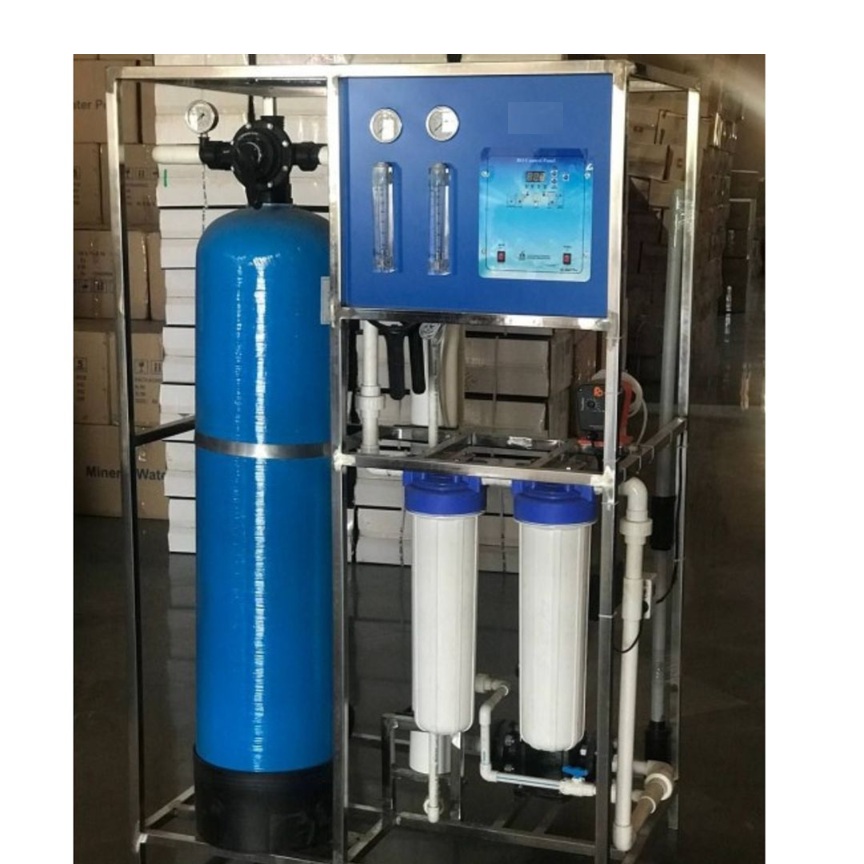
250 LPH Reverse Osmosis (RO) Plant
Capacity: 250 LPH (0.25 m³/hr) — Typical single-pass recovery 60–70% (site dependent). Pre-treatment recommended: PSF → ACF → Cartridge → (Softener/Antiscalant if required) → RO skid → Permeate tank → UV / Hypo as needed.
Process Flow (typical)
If feed turbidity is high or variable (ETP/STP permeate), add an upstream UF. If hardness > 200 mg/L, use softener or antiscalant.
Design Basis & Digit-by-Digit Calculations
Permeate required P = 250 LPH = 250 litres per hour.
Convert to cubic metres per hour: 250 ÷ 1000 = 0.250 m³/hr.
Assume recovery R = 70% (typical for low-TDS feed). Adjust after feed data.
Feed & Reject Flow
Convert to LPH: Feed ≈ 0.357 × 1000 = 357 LPH.
Reject Qr = Qf − P = 357 − 250 = 107 LPH.
Membrane Area & Element Count (Indicative)
Required membrane area A = Permeate (L/hr) ÷ flux = 250 ÷ 16 = 15.625 m².
Typical 8" × 40" element active area ≈ 6.0 m² → elements ≈ 15.625 ÷ 6.0 = 2.604 → round up to 3 elements (common package: 1 pressure vessel with 3 elements or 1 × 4040 vessel with 3 elements in series).
Practical arrangement: 1 × 8"×40" vessel with 3 elements (or 1 × 8"×48" depending on vendor). For redundancy use 2 parallel trains (smaller elements) if required.
Pre-treatment & Protection
- PSF (Pressure Sand Filter): remove turbidity & suspended solids.
- ACF (Activated Carbon Filter): remove chlorine & organics.
- Cartridge Filters: 5 µ → 1 µ cartridges before HP pump.
- Anti-scalant or Softener: required if hardness / silica risk present.
- UF (optional): if feed turbidity or SDI high (e.g., ETP permeate, surface water).
High Pressure Pump & Power Estimate
Practically, use a 0.5 – 1.0 kW HP pump (duty), or 1.5 kW if you want more margin and higher pressure. Choose pump with VFD for smooth operation and energy saving.
Membrane, Skid & Accessories
| Item | Specification / Note |
|---|---|
| Membrane | Polyamide TFC 8" elements (3 nos) or equivalent |
| Skid | MS powder coated / SS304 skid, compact layout |
| Pre-filters | PSF + ACF + Cartridges (5 µ → 1 µ) |
| Pumps | Feed pump, HP pump (0.5 – 1.0 kW), permeate pump |
| Instruments | TDS meters (feed & permeate), pressure gauges, flow meter |
| CIP | Manual CIP provision; small CIP kit optional |
Performance Expectations & Applications
| Parameter | Feed (typical) | Permeate (expected) |
|---|---|---|
| TDS | 500 – 1500 mg/L (site dependent) | Depends on membrane rejection (90–98%) |
| Permeate Flow | — | 250 LPH (design) |
| Use | Small packaged water, labs, hostels, restaurants, small factories | Drinking / process water after post treatment |
Operation & Maintenance
- Monitor feed & permeate TDS, and pressures; replace cartridges regularly.
- Schedule CIP when flux falls or TMP increases.
- Keep spare elements (1 spare element recommended) and spare cartridges.
- Use anti-scalant where hardness risk exists and follow vendor membrane maintenance recommendations.
FAQ — 250 LPH RO Plant
Q1: What is the price of a 250 LPH RO Plant?
Price depends on feed TDS, pre-treatment required and automation. Contact us for best price; we will provide Excel quote.
Q2: What power is required?
Typically a 0.5 – 1.0 kW high-pressure pump motor depending on design head; single phase or 3-phase options available.
Q3: How much space is needed?
Approximately 3 ft × 4 ft for skid + pre-treatment area (depends on pre-treatment layout).
Q4: Do you do installation & AMC?
Yes — we offer installation, commissioning, operator training and AMC packages.