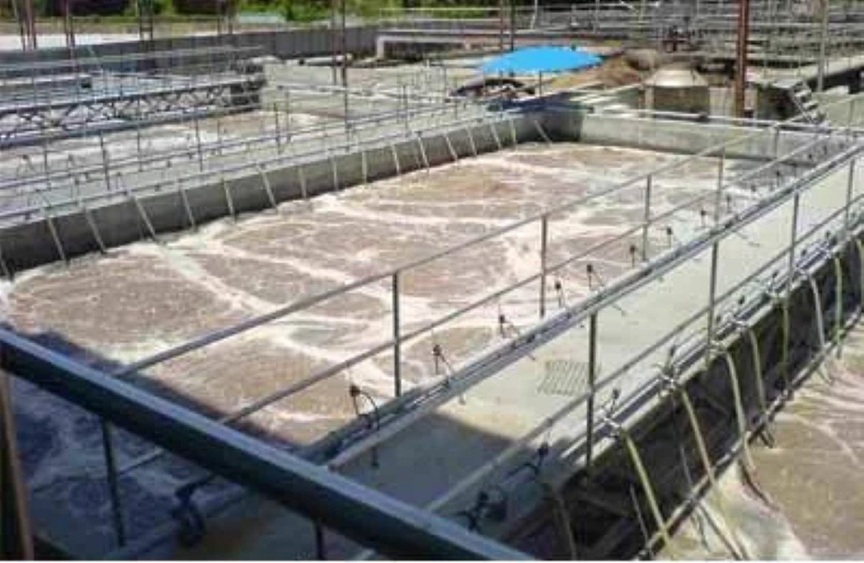
300 KLD Sewage Treatment Plant — ASP (Activated Sludge Process)
Overview
This 300 KLD (300 m³/day) Activated Sludge Plant is engineered for continuous duty with focus on regulatory compliance (TNPCB / CPCB), low sludge yield and stable performance under variable loading. Default design assumptions used below: 20 operating hours/day, influent BOD₅ = 250 mg/L. Final guarantees provided after site survey & influent lab report.
Process Flow — Text Diagram
Design Basis & Digit-by-Digit Calculations
- Design flow Qday = 300 m³/day
- Operating hours = 20 hr/day (used for hourly conversions)
- Hourly flow Qhr = 300 ÷ 20 = 15.00 m³/hr (15,000 LPH)
- Design HRT (aeration) chosen = 6 hours (typical range 4–8 h for ASP)
- Design MLSS = 3,000 mg/L (3.0 kg/m³) (typical)
- Surface Overflow Rate (clarifier) = 30 m³/m²·day (typical)
1) Hourly Flow
2) Aeration Tank Volume (HRT method)
3) MLSS Mass
4) Secondary Clarifier (SOR)
Circular clarifier diameter d = √(4A/π) = √(40/3.1416) ≈ 3.57 m → choose practical diameter 4.0 m (allow weir and maintenance). Depth and hopper shape designed per standards.
5) BOD Load & Oxygen Requirement
Oxygen demand (1.4 kg O₂/kg BOD removed) → O₂ ≈ 75 × 1.4 = 105 kg O₂/day.
Conservative blower sizing using 1.2 kg O₂/kW → blower power ≈ 105 ÷ 1.2 = 87.5 kW. Recommend multiple blowers (e.g., 3 × 30 kW duty/standby) and VFD control — final blower selection after OTR (oxygen transfer rate) and site-temperature corrections.
Note: this is a conservative estimate. Real blower sizing should use diffuser OTR data, depth, temperature and DO setpoint — we will finalize after site details.
6) Sludge Generation (Estimate)
At 3% cake solids: wet sludge ≈ 37.5 ÷ 0.03 ≈ 1,250 L/day (1.25 m³/day). Provide sludge sump, thickening and dewatering (centrifuge / filter press or drying beds) sized accordingly.
Main Components & Scope of Supply
- Bar screen & comminutor (if required)
- Grit & Oil-Grease removal chamber
- Collection / Equalization tank with mixer and level instruments
- Raw sewage transfer pumps (duty + standby)
- Primary settling (if required), ASP Aeration Tank (90 m³ working) with fine-bubble diffusers
- Blowers with air manifold (multiple units with VFD & redundancy)
- Secondary Clarifier (4.0 m dia or multiple tanks)
- Polishing: Pressure Sand Filter / Activated Carbon Filter / Cartridge Filters / UF optional
- Disinfection: UV skid and / or Hypochlorite dosing system
- Sludge handling: sludge sump, thickener, dewatering (filter press / decanter / drying beds)
- Electrical & Control: PLC, MCC, level sensors, DO sensors, online TDS/SDI where needed
- Piping (UPVC/HDPE/SS), valves, civil anchors, installation & commissioning
Regulatory Compliance — TNPCB / CPCB
Design will meet applicable TNPCB / CPCB discharge standards. Typical compliance measures included in scope:
- Design to meet BOD, COD, TSS, Oil & Grease, and Faecal Coliform / E. coli limits as per notified standards (final limits depend on receiving body and reuse purpose).
- Effluent monitoring points and sampling ports as per regulatory requirements.
- Provision for treated effluent quality certificates, consent documentation support and statutory test assistance (upon request).
- Provision for tertiary polishing and disinfection where reuse or stricter discharge limits are required.
We assist with permit paperwork and technical reports required for CPCB/TNPCB approvals (scope can be included in proposal).
Chemical Dosing & Utilities
- Chlorine / Sodium Hypochlorite: Final disinfection dosing and break-point chlorination (dosing skid + storage + dosing pumps).
- Polymer (Flocculant): Sludge dewatering & thickening aid (dosed to sludge sump or thickener).
- pH correction: Acid / Alkali dosing for process control (if required for neutralization).
- Anti-foaming agent: For aeration tanks if foam occurs.
- Coagulant (Alum / PAC): For tertiary polishing if needed for TSS/colour removal.
- Brine / chemical safe storage area with bunding and ventilation.
Chemical quantities and dosing rates calculated after influent analysis. We provide dosing skid, pumps, and safe storage as part of supply on request.
Technology Comparison (ASP vs MBBR vs SBR vs MBR)
| Technology | Key Advantages | Best Use |
|---|---|---|
| ASP | Well-proven, simple operation, cost-effective for steady flows | Large municipal or continuous industrial flows where footprint available |
| MBBR | Smaller footprint, tolerant to shock loads, less sludge | Space-limited sites, variable load applications |
| SBR | Batch flexibility, compact, good control over cycles | Intermittent flows, small to medium communities, retrofit projects |
| MBR | Very high effluent quality, very low TSS, small footprint | Reuse critical projects, tight discharge limits, space constraint |
Expected Performance & Reuse
| Parameter | Typical Influent | Expected Effluent (After ASP + Polishing) |
|---|---|---|
| BOD₅ | 200 – 400 mg/L | < 30 mg/L (with tertiary polishing & good O&M) |
| TSS | 150 – 350 mg/L | < 30 – 50 mg/L |
| COD | 600 – 1200 mg/L | < 200 – 300 mg/L |
| Turbidity | Varies | < 5 NTU (with PSF / UF) |
| Use | — | Toilet flushing, landscaping, cooling towers (after disinfection and necessary polishing) |
We provide performance guarantees only after acceptance of supply scope and review of water test reports (jar test & lab data).
Operation & Maintenance
- Daily: inspect screens, pumps, blowers, DO (≥2 mg/L typical), sludge blanket, check alarms.
- Weekly: clean scum & grit chambers; check blower & diffuser performance.
- Monthly: calibrate DO & pH sensors, inspect clarifier weirs and desludge if needed.
- Periodic: dewater sludge, service blowers, replenish chemicals and train operators.
- We offer operator training, spares kit and AMC packages tailored to site requirements.
FAQ — 300 KLD STP (ASP)
Q1: How many users does a 300 KLD STP serve?
Assuming 100–150 L/person/day, 300 KLD can serve roughly 2,000–3,000 persons. Actual capacity depends on site-specific water consumption patterns.
Q2: What are the typical lead times?
Typical supply lead time for standard ASP equipment: 6–10 weeks. Civil works & installation vary by site; turnkey delivery normally 10–16 weeks depending on scope.
Q3: Do you provide statutory documentation & approvals support?
Yes — we assist in preparing technical documents for TNPCB / CPCB applications and provide performance test certificates after commissioning.
Q4: What test data do you need to finalise design?
Please share influent lab report: BOD, COD, TSS, TDS, FOG, pH, temperature, and any industrial contaminants. We offer jar tests and on-site analysis for accurate guarantees.