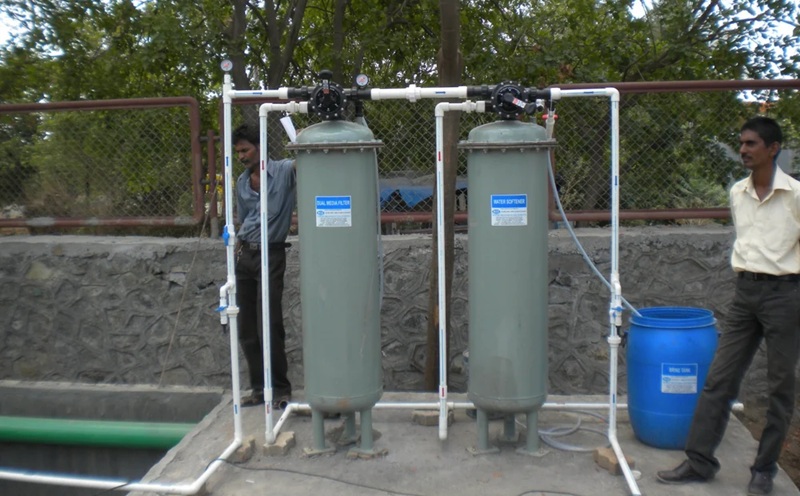
3000 LPH Water Softener Plant — FRP Vessel (Auto MPV + Brine Tank)
Quick Summary
Design flow: 3,000 LPH (72.0 m³/day at 24 hr).
Hardness handled: 300 → 900 mg/L (as CaCO₃).
Vessel type: FRP (fiberglass) pressure vessels.
Accessories: Automatic Multi-Port Valve (Auto-MPV), Brine tank, Brine dosing, Resin (strong acid cation), Piping, Control panel, Commissioning.
Working Principle
The water softener uses strong-acid cation (SAC) resin in sodium form. Hardness ions (Ca²⁺ & Mg²⁺) are exchanged with Na⁺ on the resin. When resin capacity is exhausted, automatic regeneration (brine backwash & rinse) restores sodium form and the softener comes online again without manual intervention.
Design Assumptions
- Permeate (soft water) required = 3,000 LPH (continuous 24 hr basis → 72.0 m³/day)
- Accepted inlet hardness range = 300 mg/L to 900 mg/L (as CaCO₃)
- Resin working capacity (assumed conservative) = 30,000 grains/ft³ (typical strong-acid cation resin; final vendor selection may vary)
- Regeneration frequency assumed = once per day (can be extended to 2–3 days by increasing resin volume)
- Salt dosage per regeneration assumed = 10 lbs/ft³ ≈ 4.536 kg/ft³ (typical industry practice; final will depend on resin & site)
- 1 grain = 64.79891 mg (used in grain ↔ mg conversions)
Sizing Calculations — Step by step (digit-by-digit)
Goal: calculate required resin volume (in ft³ and m³) to handle worst-case hardness = 900 mg/L with regeneration once per day. We show 300 mg/L and 900 mg/L examples.
Common conversions used
Step A — Daily soft water volume
Daily volume = 3.0 m³/hr × 24 hr = 72.0 m³/day = 72,000 L/day.
Step B — Total hardness mass to remove per day
Convert to grams: 21,600,000 ÷ 1000 = 21,600 g/day = 21.6 kg/day. 2) For 900 mg/L: Hardness_mass_900 (mg/day) = 72,000 × 900 = 64,800,000 mg/day.
Convert to grams: 64,800,000 ÷ 1000 = 64,800 g/day = 64.8 kg/day.
Step C — Resin capacity in mg per ft³ (digit-by-digit)
1 grain = 64.79891 mg → Resin_capacity_mg = 30,000 × 64.79891 = 1,943,967.3 mg/ft³
Step D — Required resin volume (ft³)
Step E — Convert ft³ → m³ (and litres)
Step F — Salt (NaCl) required per regeneration (approx.)
Interpretation & recommended practical arrangement: To support variable hardness up to 900 mg/L and ensure redundancy, we recommend either:
- Use TWO identical softener trains (lead + standby) each sized ~18 ft³ resin (~0.51 m³) and alternate regeneration (this allows continuous supply during regeneration), or
- One single large vessel containing ~33.5 ft³ resin (≈0.944 m³) with an automatic valve — but note regeneration will take the vessel offline during brining; so a dual-train is preferred for continuous service.
Scope of Supply
- FRP pressure vessel(s) with internal resin bed — sized per above (we give 2-train & single-train options)
- Automatic Multi-Port Valve (Auto-MPV) with timer / meter regen options (digital control)
- Brine tank (HDPE) sized to store salt for multiple regenerations
- Strong-acid cation resin (SAC), pre-loaded
- Brine dosing system, salt grid & injector
- Feed strainer, pressure gauges, sample ports, inlet/outlet piping (UPVC/HDPE/SS), bypass, drain piping
- Control panel with manual/auto mode, level sensors for brine tank
- Installation, commissioning, operator training & initial resin performance test
Operation & Regeneration Details
- Regeneration cycle (typical): Backwash → Brine draw (slow rinse) → Fast rinse → Refill brine tank (if equipped) → Return to service.
- Regeneration triggers: Time-based (once/day) or meter-based (m³ treated) — meter-based is recommended for variable hardness loads.
- Backwash flow rate: ~ 50–70 L/min/m³ of resin (vendor to confirm) to remove suspended solids from resin bed.
- Brine concentration: Typically 10–12% NaCl solution prepared in brine tank.
- Salt handling: Recommend quality industrial salt (NaCl) with ≥ 95% purity and dry storage in brine room.
Applications & Why Choose This Softener
- Protects boilers, heat exchangers, chillers and process equipment from scale
- Improves detergent efficiency in laundries and hospitality operations
- Extends life of RO membranes when softening used as pre-treatment
- Auto-MPV & brine tank enable automatic, low-maintenance regeneration
- FRP vessels provide corrosion resistance and low maintenance
Expected Performance & Quality Control
Post-softener hardness typically < 1–5 mg/L (depending on regeneration performance & resin quality). We provide commissioning test: inlet/outlet hardness profile, salt usage verification, and service & AMC options to maintain consistent performance.
| Parameter | Typical Value |
|---|---|
| Design flow | 3,000 LPH (72 m³/day) |
| Hardness range handled | 300 – 900 mg/L (as CaCO₃) |
| Typical outlet hardness | < 5 mg/L (target, after proper regen) |
| Resin (example) | SAC, 30,000 grains/ft³ (vendor resin available) |
Operation & Maintenance
- Daily: check inlet pressure, outlet hardness, brine tank level, Auto-MPV status
- Weekly: inspect brine tank salt level, clean strainer, check drain lines
- Monthly: record salt consumption, verify resin performance via sample tests
- Annual: resin performance audit and possible partial replacement after several years depending on feed & fouling
- We provide commissioning, resin warranty (as per vendor), spares & AMC packages
FAQ
Q: Why give two resin sizing numbers (11.11 ft³ and 33.33 ft³)?
Those are example resin volumes to handle daily loads if regeneration is done once every 24 hours — 11.11 ft³ handles 300 mg/L hardness; 33.33 ft³ handles 900 mg/L. For continuous service we normally recommend two trains or a lead/lag arrangement.
Q: What salt quality is recommended?
Use industrial-grade NaCl with ≥95% purity, stored dry. Avoid salt with high insoluble matter to prevent brine tank issues.
Q: Will this protect an RO downstream?
Yes — softening to <1–5 mg/L hardness significantly reduces scaling risk on RO membranes. We still recommend antiscalant dosing and periodic monitoring.