20,000 LPH Industrial Water Softener Plant
Overview
This 20,000 LPH (20 m³/hr) water softener is designed to protect downstream process equipment (RO membranes, boilers, heat exchangers) by removing hardness (Ca²⁺ & Mg²⁺) via ion-exchange (strong-acid cation resin, Na⁺ form). Typical installations: large industries, packaged water plants, hotels, hospitals, textile & dyeing, chemical plants and utilities requiring continuous softened water.
Process Flow (text diagram)
UF can be placed after ACF (recommended for turbid feeds) especially if feed is ETP/STP effluent or surface water. For very high iron, consider iron removal pre-filter.
Technical Specifications
| Model | RRR-WS-20000 |
|---|---|
| Rated Flow | 20,000 LPH (20.000 m³/hr) |
| Technology | Brine-regenerated Strong Acid Cation (SAC) Resin (Na⁺ form) |
| Designed Raw Hardness | Up to 300 – 600 mg/L (CaCO₃) (custom design for higher) |
| Outlet Hardness | < 50 mg/L (adjustable / guaranteed on site test) |
| Regeneration | Automatic (time / metered) or manual — brine prepared from NaCl |
| Vessel MOC | FRP / MS Rubber Lined (MSEP) / SS on request |
| Control | PLC / Timer / Meter-based control with level sensors |
| Operation Hours | Design default: 20 hours/day (confirm site) |
| Brand | RRR ENVIRO SYSTEMS |
Design Calculations (digit-by-digit)
Flow Q = 20,000 LPH (litres per hour). Convert to cubic metres per hour: 20,000 ÷ 1,000 = 20.000 m³/hr.
We use conservative service velocity v = 10 m/hr (typical design 8–12 m/hr).
Resin Volume (V)
Step-by-step:
So the total resin volume required ≈ 2.0 m³ (2000 L) for continuous service at 10 m/hr. Exact resin volume can be adjusted depending on desired run length and raw hardness.
Vessel Area & Diameter (single-vessel vs parallel)
Area A = V ÷ H = 2.000 ÷ 0.8 = 2.5 m².
Convert area to diameter:
A single vessel would require ~1.78 m (1785 mm) diameter — large and hard to handle. Best practice: split into multiple vessels in parallel (recommended 4 vessels approach below).
Recommended parallel configuration (for maintainability)
For each vessel: A = 0.500 ÷ 0.8 = 0.625 m².
Compute diameter:
So each vessel ~900 mm diameter × bed depth 0.8 m (vessel height ~1.2–1.5 m including freeboard). This is practical for FRP vessels (~900 mm dia) and allows one-vessel maintenance without shutdown (N+1 redundancy recommended).
Backwash & Regeneration Details
Backwash Flow (per vessel)
Backwash pump should supply ~31.25 m³/hr for each vessel during backwash. Use a suitably sized backwash pump (common practice: centralized backwash or dedicated backwash pumps sized for parallel operations).
Salt (Brine) Requirement & Regeneration
Total resin = 2.000 m³ → Salt per regeneration = 10 × 2.000 = 20 kg NaCl per regeneration cycle.
Recommend salt storage: 500 kg (10–25 regenerations on-site depending on run length) and brine prep tank ~300–500 L for convenience. Actual salt use depends on raw hardness and chosen regen strength (8–12 kg/m³ typical range).
Regeneration Frequency & Run Length
Scope of Supply & Equipment
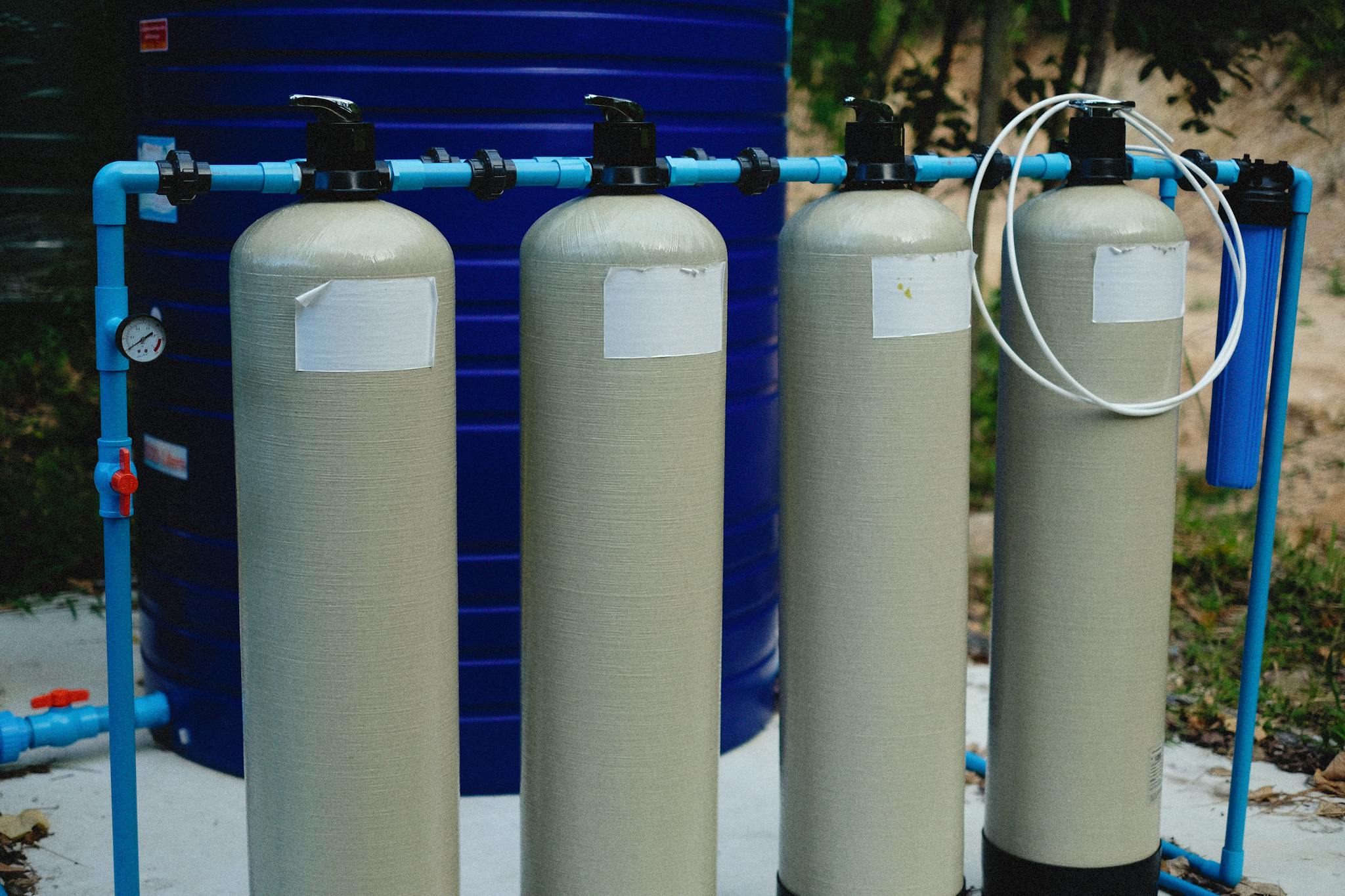
- 4 × FRP softener vessels (900 mm dia × suitable height) with multiport valves (automatic or manual)
- Strong Acid Cation resin (total ~2.0 m³ / 2000 L)
- Brine preparation tank, salt hopper & salt feed arrangement
- Raw / treated water pumps (duty + standby) sized for site head
- Backwash pump (centralized or per-vessel) & drain piping
- Cartridge prefilters, PSF & ACF as required
- Control panel (PLC / Timer-based) with level switches and regeneration logic
- Piping (PP / MS / SS), valves, pressure gauges, flow meters
- Installation, commissioning, operator training & O&M manual
Expected Performance & Use Cases
| Parameter | Typical Inlet | Expected Outlet |
|---|---|---|
| Hardness (as CaCO₃) | 100 – 1000 mg/L (site dependent) | < 50 mg/L (after softening) |
| TSS / Turbidity | Varies | Pre-filtration recommended (<1 NTU to protect resin) |
| Iron | < 2 mg/L recommended | Must be removed pre-softener otherwise resin fouls |
| Use | RO feed, boilers, cooling towers, process water | Reduced scaling, longer RO life, less boiler blowdown |
Final guarantees provided after site raw water report & jar tests. We include initial site sample analysis in our proposal (free for serious enquiries).
Operation & Maintenance
- Periodic backwash & regeneration per control schedule (timer or meter-based).
- Monitor inlet iron — pre-treat if Fe > 0.2–0.5 mg/L to avoid resin fouling.
- Maintain salt stock and brine strength checks.
- Keep spare resin (5–10% by volume) and critical spares: valves, seals, pumps.
- Annual resin performance check & periodic resin replacement as per use.
FAQ — 20,000 LPH Water Softener
Q1: What is the salt consumption per regeneration?
Using 10 kg NaCl per m³ resin as working value → total resin 2.0 m³ → salt ≈ 20 kg per regeneration. Actual consumption depends on resin & hardness; range 8–12 kg/m³ is common.
Q2: How often will the softener need regeneration?
Regeneration frequency depends on inlet hardness and demand. Typical schedules vary from daily to every few days. Meter-based control gives optimal salt usage.
Q3: Can this be used as RO pretreatment?
Yes — softeners are commonly used before RO when hardness would cause scaling. For turbid feeds, add UF pre-treatment to protectRO membranes.
Q4: Do you provide installation and AMC?
Yes — we provide supply, installation, commissioning, operator training and AMC packages across India.