30 KLD Sewage Treatment Plant — ASP (Activated Sludge Process)
Quick Summary
Capacity: 30 KLD (30 m³/day). Typical application: residential complexes, schools, small hospitals, hostels. Design operational hours (default): 20 hours/day (we use this for working calculations). Final design to be confirmed after site survey & influent characteristics (BOD, COD, TSS, FOG, pH).
Process Flow (Text Diagram)
Sludge from primary/secondary → Sludge sump → Sludge thickening → Dewatering (drum/centrifuge or drying bed) → Disposal.
Design Basis & Digit-by-Digit Calculations
Two options shown: continuous 24-hour operation and design using 20 hours/day (user earlier selected 20 hrs).
Flow conversions
2) If 20 hours operation (design basis used here): Q = 30 ÷ 20 = 1.50 m³/hr (≈ 1500 LPH).
Aeration Tank Volume (HRT method)
Using Q (operational) = 1.50 m³/hr → Volume V = Q × HRT = 1.50 × 6 = 9.0 m³ (9,000 L).
MLSS & Mixed Liquor Volume
Secondary Clarifier – Surface Area (SOR method)
Area A = Q_day ÷ SOR = 30 ÷ 30 = 1.0 m².
Circular clarifier diameter d = √(4A/π) = √(4 × 1 / 3.1416) ≈ 1.13 m (practical choose 1.5–2.0 m diameter for weir & maintenance).
Air Requirement (approximate)
BOD load per day = Q_day × BODconc = 30 m³/day × 250 mg/L = 30 × 250 g/day = 7,500 g/day = 7.5 kg BOD/day.
Typical oxygen requirement ≈ 1.2 – 1.6 kg O₂/kg BOD removed. Assume 1.4 kg O₂/kg BOD and 80% removal design → O₂ demand = 7.5 × 1.4 = 10.5 kg/day. Blower sizing (including safety & system losses): assume 1.0–1.2 kg O₂/kW (practical) → approximate blower power ~ 1.5 – 3.0 kW (choose 2 kW blower with blowers redundancy for reliability).
Note: blower sizing must be refined after exact influent BOD, temperature & system oxygen transfer efficiency (OTR) are known.
Sludge Production (estimate)
Main Components & Equipment
- Inlet Bar Screen & Grit / Oil & Grease Trap
- Collection / Equalization Tank with mixer & level control
- Raw Sewage Transfer Pump (submersible / dry pit)
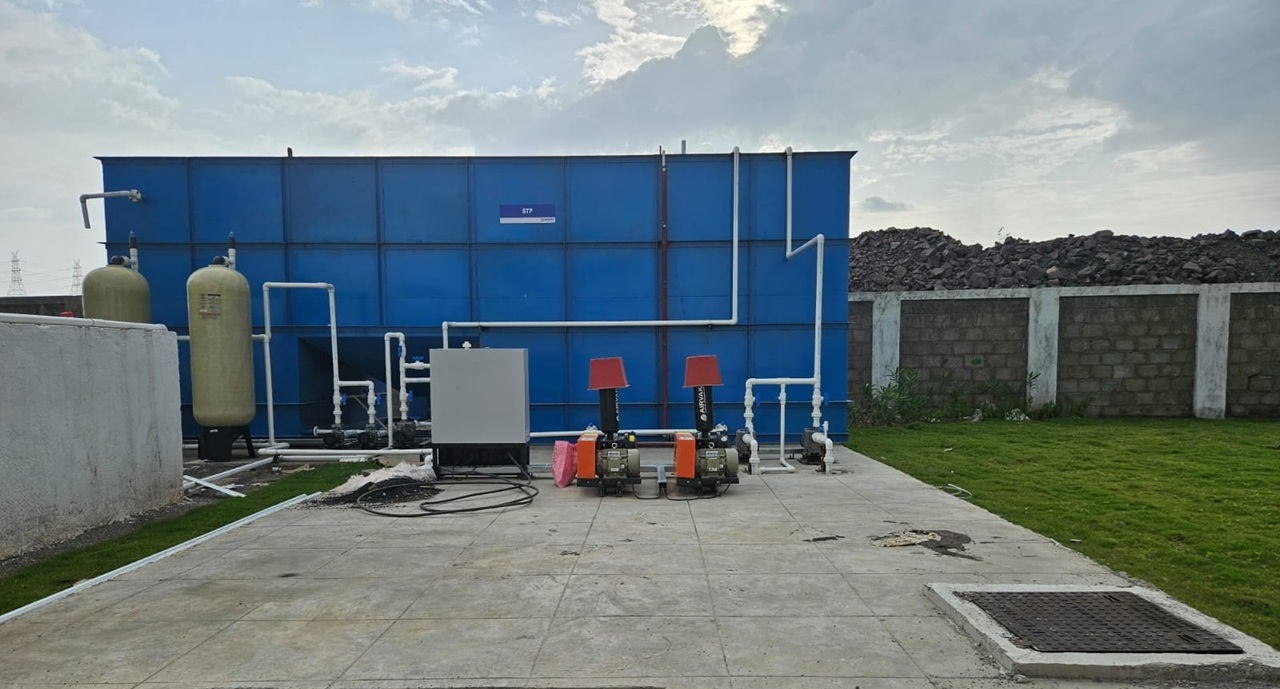
- ASP Aeration Tank with fine bubble diffusers & blowers (2 kW x duty+standby)
- Secondary Clarifier with sludge hopper & RAS (Return Activated Sludge) pump
- Polishing (PSF / Sand + Carbon / Cartridge / UF optional)
- Disinfection: UV or Sodium Hypochlorite dosing system
- Sludge sump, sludge thickener / drying bed or mechanical dewatering (filter press / decanter)
- PLC / Control Panel, Level sensors, Flow meters, Online pH & DO sensors (optional)
Expected Performance (Typical)
| Parameter | Typical Influent | Expected Effluent (After STP) |
|---|---|---|
| BOD₅ | 200 – 400 mg/L | < 20 – 30 mg/L (with good operation) |
| Suspended Solids (TSS) | 150 – 350 mg/L | < 30 – 50 mg/L |
| COD | 600 – 1200 mg/L | < 150 – 250 mg/L (varies) |
| Turbidity | Varies | < 5 NTU (with polishing) |
| pH | 6.5 – 8.5 | 6.5 – 8.5 |
Effluent quality depends on influent characteristics, proper O&M and polishing stage. For reuse (toilet flushing / landscaping / cooling tower), additional polishing (UF / RO) and disinfection may be required.
Operation & Maintenance
- Daily: check pumps, blowers, DO (≥2 mg/L typical), inlet screens and desludging schedule.
- Weekly: inspect diffusers, check RAS rate and sludge blanket in clarifier.
- Monthly: calibrate sensors, grease bearings, clean screens and dosing tanks.
- Quarterly/Annually: sludge drying/dewatering, blower maintenance, performance audit and online instrument calibration.
- Provide operator training, maintenance manual and spare parts list. AMC packages available.
FAQ — 30 KLD STP (ASP)
Q1: What is included in the quoted STP?
Supply of equipment (pumps, blowers, diffusers, valves), fabrication of tanks (RCC/FRP/MSEP), control panel, instrumentation, piping & installation, commissioning and performance testing (subject to scope agreed).
Q2: How many users does 30 KLD typically serve?
Assuming 100–150 L/person/day, 30 KLD can serve roughly 200–300 persons. Actual depends on site-specific water use patterns.
Q3: Do you provide statutory compliance support?
Yes — design and operation can be tailored to meet TNPCB / CPCB norms and we provide documentation for permits on request.
Q4: What maintenance frequency is needed?
Daily operational checks, weekly diffuser & sludge checks, monthly instrument calibration and periodic sludge dewatering (frequency depends on sludge generation).