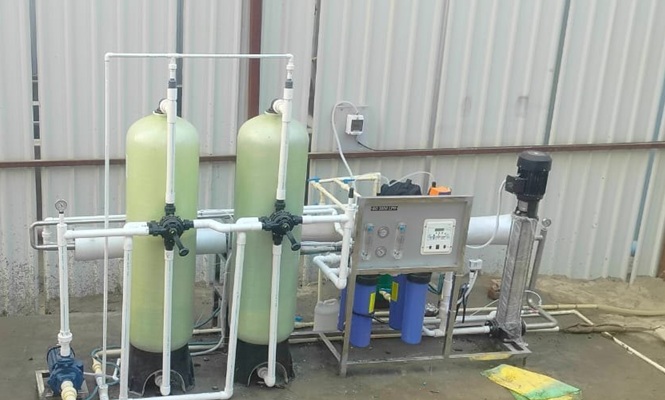
3000 LPH Reverse Osmosis Plant (3 m³/hr)
Quick Summary
Permeate (product): 3,000 LPH (3.0 m³/hr) — assumed operation: 24 hr/day → daily production ~72 m³/day.
Design recovery: 75% (assumption).
Applications: Drinking water for small communities, hotels, process water for industries, mineral water lines (after proper post-treatment), boiler feed (with proper softening), lab & dialysis pre-treatment (with additional polishing).
Digit-by-Digit Design Calculations (assumptions listed)
- Permeate flow = 3,000 LPH
- Operating hours = 24 hr/day
- Recovery = 75%
- Design flux = 20 LMH (L/m²·hr)
- Element active area ≈ 2.8 m²/8" element
- Specific energy assumption ≈ 0.6 kWh/m³ (conservative for brackish RO) — used for energy estimate only
Step 1 — Convert permeate flow
Convert to m³/hour: 3,000 ÷ 1000 = 3.0 m³/hr.
Daily permeate = 3.0 × 24 = 72.0 m³/day (= 72,000 L/day).
Step 2 — Feed & Reject flow (recovery method)
Feed flow (LPH) = Permeate ÷ R = 3,000 ÷ 0.75 = 4,000 LPH (4.0 m³/hr).
Reject (concentrate) = Feed − Permeate = 4,000 − 3,000 = 1,000 LPH.
Step 3 — Membrane area (flux method)
Required area A (m²) = Permeate (L/hr) ÷ Flux (L/m²·hr) = 3,000 ÷ 20 = 150.0 m² membrane area.
Typical arrangement: 6 elements per pressure vessel → vessels required = 54 ÷ 6 = 9 vessels (6-element vessels).
Step 4 — High pressure pump & energy
Daily energy (kWh/day) = Permeate_m3day × Esp = 72.0 × 0.6 = 43.2 kWh/day.
Average electrical power (kW) = 43.2 ÷ 24 = 1.8 kW average.
For pump & motor sizing allow margin and pressure needs — recommend a high-pressure pump with driver ≈ 3.0 kW (approx.) (3–5 kW depending on required operating pressure and losses). Use VFD for soft start and energy control. Consider booster feed pump separately if needed.
Note: final pump power depends on required RO operating pressure (feed TDS/temperature) and pump/motor efficiencies — vendor will confirm after feed TDS and target recovery.
Summary of calculated flows & sizing
| Parameter | Value |
|---|---|
| Permeate flow | 3,000 LPH = 3.0 m³/hr = 72.0 m³/day |
| Assumed recovery | 75% |
| Feed flow | 4,000 LPH = 4.0 m³/hr = 96.0 m³/day |
| Reject flow | 1,000 LPH = 1.0 m³/hr = 24.0 m³/day |
| Membrane required area (20 LMH) | 150 m² |
| Membrane elements (≈2.8 m²/element) | ≈ 54 elements (9 × 6-element vessels) |
| Estimated daily energy | ≈ 43.2 kWh/day (avg ~1.8 kW) |
Purpose & Typical Applications
- Potable water for small complexes, hostels, hotels (with post-treatment & mineralization).
- Process water for food & beverage, pharmaceuticals, labs (with further polishing as required).
- Bottled & mineral water lines (follow local regulations & additional polishing/stage validation).
- Make-up water for boilers (with softening + deaeration / proper condensate control).
- Industrial rinsing / cooling (depending on TDS spec and post-treatment).
Recommended Pre-treatment & Scope of Supply
Good pre-treatment is critical to protect RO membranes and ensure uptime. Typical recommended scope:
- Raw water intake, coarse strainer and dosing for anti-scalant
- Multimedia / Pressure Sand Filter (PSF) — removes suspended solids & turbidity
- Activated Carbon Filter (ACF) — removes chlorine, organics, odour
- Water softener (if hardness & Ca/Mg high) or use antiscalant if feasible
- Micron cartridge filter (5 µm → 1 µm) upstream of HP pump and membranes
- Antiscalant dosing skid / pH correction dosing (as per feedwater chemistry)
- High-pressure skid (HP pump + motor + VFD), RO skid (FRP pressure vessels), permeate & concentrate piping
- CIP (clean-in-place) system with chemical storage, dosing pumps for periodic membrane cleaning (acid & alkali)
- Conductivity / TDS meters (feed, permeate, reject), pressure gauges, flow meters, automatic valves, PLC control panel with HMI
- Permeate polishing: remineralizer / UV disinfection / final cartridge if required
Mechanical & Material Notes (MOC)
- Pressure vessels: FRP / fiber-reinforced pressure vessels for 8" membrane elements
- Piping: UPVC / HDPE for low pressure lines; SS304/316 for HP/permeate headers as needed
- Pumps: high-pressure multistage centrifugal or positive displacement as per pressure needs; motors with VFD
- Skids & frames: MS painted / SS as per site corrosivity
- Membranes: branded seawater/brackish RO membranes per feed TDS (vendor to specify)
- Electrical: MCC, starter, VFD, earthing, local isolators & lightning protections
Expected Performance & Water Quality
Expected permeate TDS reduction depends on feed TDS and membrane type. Typical brackish RO removal 85–98% TDS reduction. Example: feed TDS 1000 mg/L → permeate ≈ 20–150 mg/L depending on membranes and recovery. Final water should be validated and may require remineralization for potable use.
| Parameter | Typical Feed | Expected Permeate |
|---|---|---|
| TDS | Varies (e.g., 500–2000 mg/L) | Depends on membrane: typically 50–200 mg/L |
| Turbidity | >1 NTU | < 0.5 NTU (after proper pre-treatment & membranes) |
| SDI | May be > 3 | < 3 (required for long membrane life) |
Operation & Maintenance
- Daily: monitor feed/permeate TDS, flows, pressures, motor amps and alarms; check chemical dosing and cartridge status.
- Weekly: inspect pre-treatment filters, backwash PSF/ACF as required; record SDI.
- Monthly: perform membrane flushing, check CIP scheduling; inspect pump seals & coupling.
- Quarterly / Biannual: chemical CIP (acid/alkali) as per fouling; replace worn cartridges; check membrane integrity.
- Keep spare parts: 1–2 membrane elements, cartridges, seals, dosing pumps & key instrumentation spares.
- We offer commissioning, start-up assistance, training and AMC packages.
FAQ — 3000 LPH RO Plant
Q: What feed data do you need to finalise the design?
We need raw water lab report: TDS, Conductivity, SDI, Turbidity, Hardness (Ca/Mg), Iron, Manganese, Chlorine, Oil & Grease, pH, Temperature and any organics/heavy metals present.
Q: What is the expected recovery & reject handling?
We designed here for 75% recovery → reject ~25%. For 3,000 LPH permeate feed = 4,000 LPH, reject = 1,000 LPH. Reject handling options: drain (if regulations allow) or evaporation / zero liquid discharge integration or use for gardening where permitted.
Q: Will this plant make potable water directly?
Permeate quality depends on feedwater and membranes. Typically RO permeate needs post-treatment (remineralization, disinfection) before being declared potable as per local norms. We can include remineralizer/UV & sample validation on commissioning.
Q: What is membrane life & CIP frequency?
Membrane life typically 3–7 years depending on feed & maintenance. CIP frequency varies (2–12 months) depending on fouling rate and feed quality.